

State of the Art
Subscribe Now!The Museum of Nebraska Art reopens with a fresh lens on what it means to be “of Nebraska.”





After four years of silence, the Museum of Nebraska Art is alive again. Light streams through a new glass façade, visitors trickle into reimagined galleries and the hum of conversation carries through soaring, timber-framed spaces.
Located in the heart of downtown Kearney – surrounded by brick storefronts, small cafes and century-old architecture – MONA is both a cultural landmark and a community anchor. But its latest transformation is more than cosmetic. The museum has doubled in size to 54,000 square feet and added new galleries and education spaces – part of a $38.5 million expansion supported by a capital campaign and $7.5 million in state funding.
The new MONA is a study of contrast and cohesion. On one side stands the original 1911 U.S. Post Office, with its neoclassical stone columns and dignified masonry. On the other, a glass-and-timber structure that invites in the Nebraska sky. Bridging the two is a transparent corridor – a literal and symbolic link between past and present. This is more than a facelift, it is a chance to reintroduce Nebraska to its own story.
As the state’s only museum solely dedicated to Nebraska art and artists, MONA is home to the Nebraska Art Collection – a permanent archive of nearly 6,000 pieces reflecting the state’s history and identity. It remains committed to its founding purpose: celebrating the artists who were born, trained or deeply rooted in Nebraska. The expanded space now widens that lens, exploring not just who we are, but how we’ve been shaped – and how we express that experience.
Visitors entering the new wing first encounter a sculptural welcome desk by Omaha artist Todd McCollister. The desk, carved from layered wood, evokes the undulating hills of the Sandhills and the ripples of the Platte River. It sets the tone: art that mirrors the land, bends the light and reclaims meaning from the landscape.
Before the renovation, MONA could only exhibit about 2% of its permanent collection. Now, nearly 10% of its works are on view. That includes oil paintings, contemporary installations, photography, sculpture, Indigenous beadwork and a growing number of mixed-media and textile pieces.
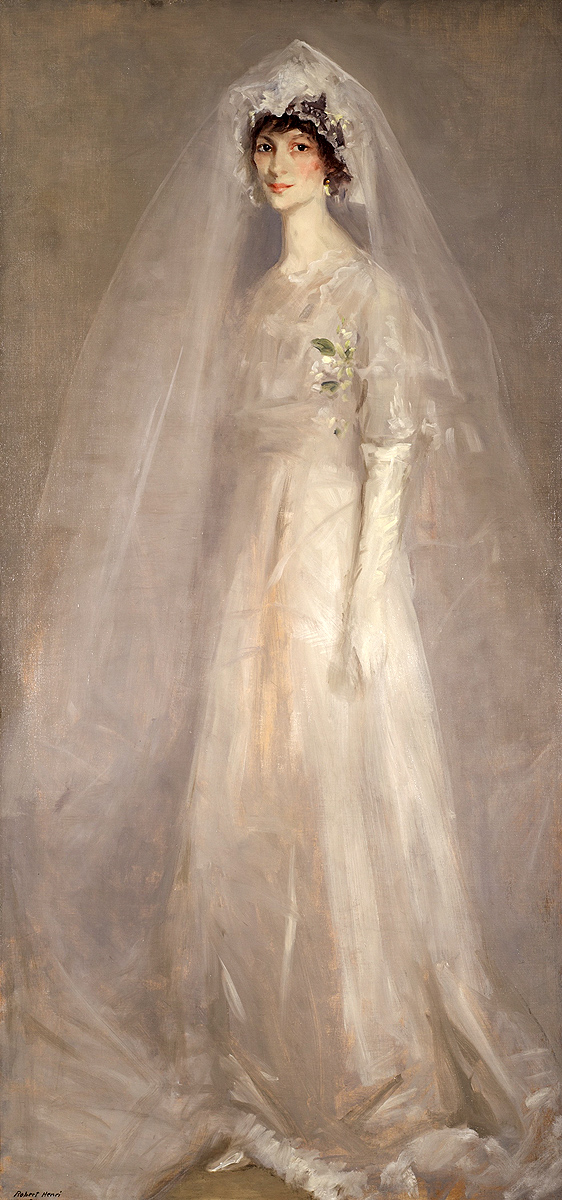
Some of the museum’s most iconic works date back more than a century. Among the standouts are Albert Bierstadt’s dramatic Great Plains sketches, John James Audubon’s hand-colored lithograph of a sandhill crane from his landmark series “Birds of America,” and Thomas Hart Benton’s full watercolor series from “The Oregon Trail.” But perhaps MONA’s most recognized painting is Robert Henri’s 1911 portrait of Miss Eulabee Dix (later Mrs. Alfred Brooks Fry) in her wedding gown. Henri – born Robert Henry Cozad – had deep ties to Nebraska; his family founded the town of Cozad before fleeing after a fatal dispute involving his father. The painting not only represents MONA’s most significant piece but also serves as a link to the museum’s mission: honoring art and artists of Nebraska, whether native, adopted or historically connected.
The collection’s range extends into the contemporary. Kent Bellows’ hyperrealist drawings remain arresting in their detail, often appearing more photographic than hand-rendered. Bellows, like Henri, is one of Nebraska’s artists whose work transcended the regional to earn national recognition.
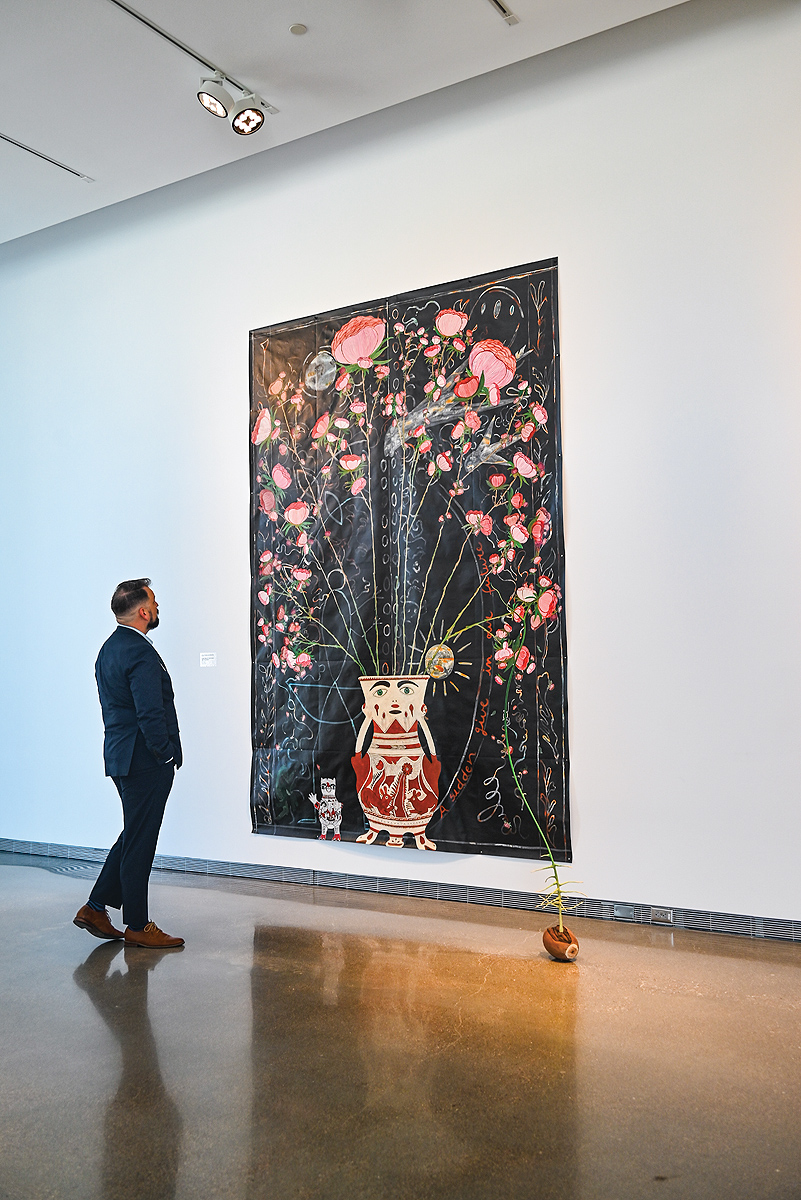
The opening exhibition, “In Search of Ourselves,” spans time, style and perspective. That same Benton series now shares a wall with Wesaam Al-Badry’s powerful photographs exploring displacement and home. Born in Iraq, Al-Badry fled with his family to a refugee camp in Saudi Arabia before eventually settling in Lincoln. His work, which has earned national recognition, challenges stereotypes and speaks to the immigrant story – and the American dream. In another gallery, Nancy Friedemann-Sánchez’s triptych “Cornucopia” juxtaposes symbols of immigration and personal mythology. Her vivid panels pull the viewer into a world that is at once Colombian and Nebraskan.
Just down the hall, “Magic and Loss” – a collaboration between Friedemann-Sánchez and her partner Charley Friedman – immerses visitors in a surreal forest of oversized acorns and whimsical trees. The installation evokes themes of memory, imagination and the shifting scale of human experience that echoes MONA’s broader exploration of identity and transformation. “It’s like walking into a magic forest,” said Executive Director Andrew Dunehoo. “You feel miniature – like ‘Honey, I Shrunk the Kids’ – surrounded by towering trees and Tyvek paintings that seem anything but static.”
Children lie on the floor, sketchpads open, drawing what they see. Across the museum, the new Anne Thorne Weaver Community Engagement Studio is filled with activity: students printing linocuts, visitors experimenting with watercolor and local artists offering demonstrations. “Education is what brings the art to life,” Dunehoo said. This isn’t just about looking at art, he added – it’s about getting your hands dirty, engaging, creating. For many, this interactive space will be the most memorable part of their visit.
MONA’s commitment to accessibility extends beyond its public-facing spaces. Behind the scenes, an expanded preservation center and state-of-the-art climate controls help protect the full collection. In the new visible storage wing, visitors peer through glass into rows of hanging artwork. These pieces are not currently on exhibit, but still part of the living archive.
A retail gallery allows visitors to purchase consignment works by Nebraska artists. Visitors can browse not only postcards and prints, but also ceramics, jewelry and small-scale sculpture. Every sale supports the MONA, which works to represent artists in the state.
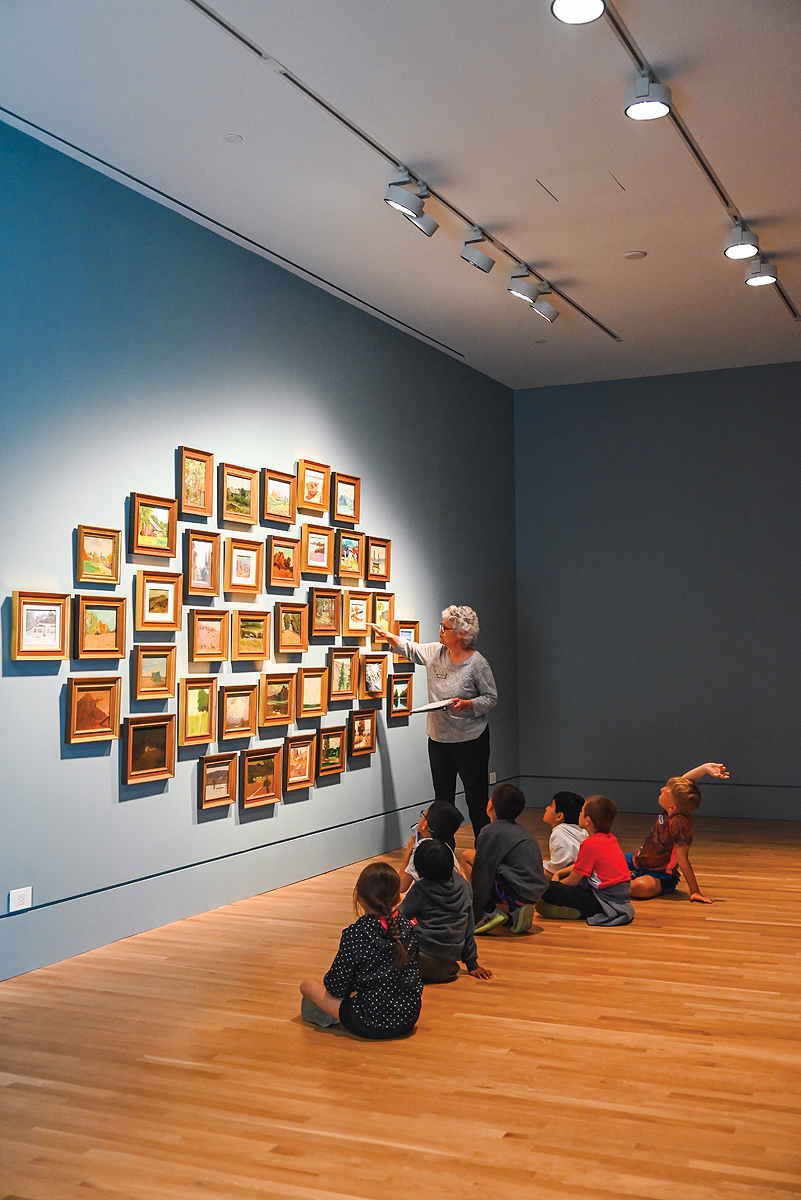
In a light-filled stairwell, a 20-foot jellyfish-like sculpture by Susan Knight floats overhead – made from Tyvek and oil paint, glowing with color and motion. Visitors enter the Rohman Gallery where classical and contemporary sit in quiet dialogue. Nearby, a group of schoolchildren sit cross-legged on the floor beneath a Lakota winter count painted on bison hide, as a guide explains how the pictographs tell a story of the seasons.
These are the kinds of stories MONA brings to light – whether by honoring tradition or challenging assumptions.
“There’s a perception that Nebraska art is all golden fields and blue skies,” Dunehoo said. “And that’s part of it. But it’s also abstract, political, personal, global. The work we show here reflects a spectrum.”
While MONA today is defined by its expansive galleries and vibrant programs, its roots run deep into the 19th century. Among the oldest works in the collection is “Stag Resting in a Landscape” (1820), a pencil sketch by famed illustrator Titian Ramsay Peale, who served as an assistant naturalist on the 1819-1820 Stephen Long expedition. He captured rare visual records of Nebraska’s early environment. These early works provide a foundational context for MONA’s ongoing commitment to showcasing the full breadth of Nebraska-related art.
Still life paintings like “Pansies and Grapes” by Helen Martanie Snowden (late 19th to early 20th century) and “Fruit” by Anna E. Reid Hall (circa 1884-1891) reflect the classical training and quiet elegance of early Nebraska artists. Hall also helped establish the Nebraska Art Association, laying the groundwork for the very institution that would become MONA.
This ambitious undertaking might never have come to life without the efforts of three Kearney State College art professors: Gary Zaruba, Larry Peterson and Jack Karraker. In the mid-1970s, the trio began collecting artwork tied to Nebraska – without a budget, a building or even a proper gallery space. What started with 30 modest pieces and a few borrowed shelves grew steadily into a respected statewide initiative. In 1979, the Nebraska Legislature formally recognized their work as the state’s official visual arts collection. MONA opened its doors in 1986 inside the repurposed 1911 U.S. Post Office building, with Zaruba serving as its first director.
Their vision – and their leap of faith – laid the groundwork for what MONA is today: not only a place to view art, but to preserve the stories of the people who make it.
The new expansion was designed by BVH Architecture of Lincoln, with construction by Hausmann. The glass-and-laminated-timber design pays homage to prairie barns and grain elevators – structures that embody both form and function.
From a certain angle, the museum looks like a hybrid of cathedral and granary. It is sacred space and working space. It is Nebraska: pragmatic, poetic and unexpectedly expansive. This vision echoes through every gallery and lingers in the final scene.
In the final room, a couple stands before a swirling abstract canvas. They don’t speak. Behind them, dozens of plein air landscapes line the wall – each one a slightly different view of the same place.
This is the tension MONA embraces: past and present, realism and abstraction, rootedness and reimagination.
As the final galleries come into view, Dunehoo reflects, “We’re not just reintroducing MONA. We’re redefining what it means to be a Nebraska artist – whether you were born here, passed through or found something here that changed you.”
MONA doesn’t offer a single answer. Instead, it offers 6,000.


The information below is required for social login
Sign In
Create New Account