

Tanks with Tales
Subscribe Now!Four Nebraska water towers that rise from utility to identity


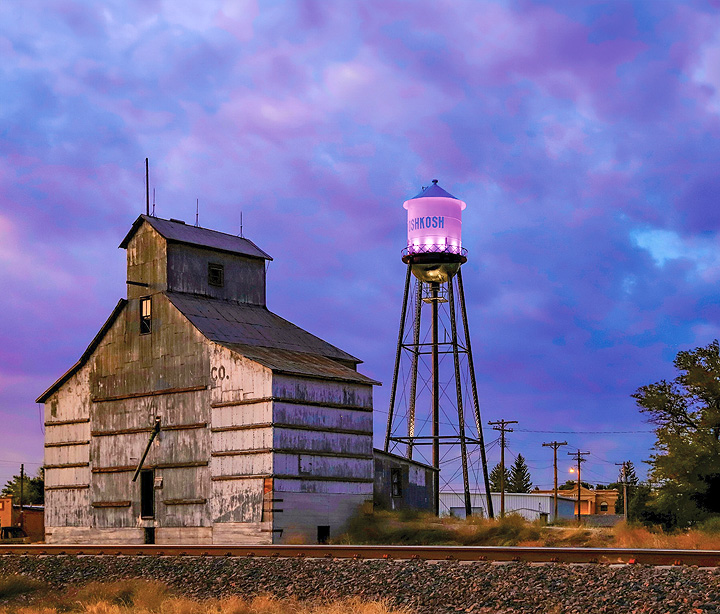

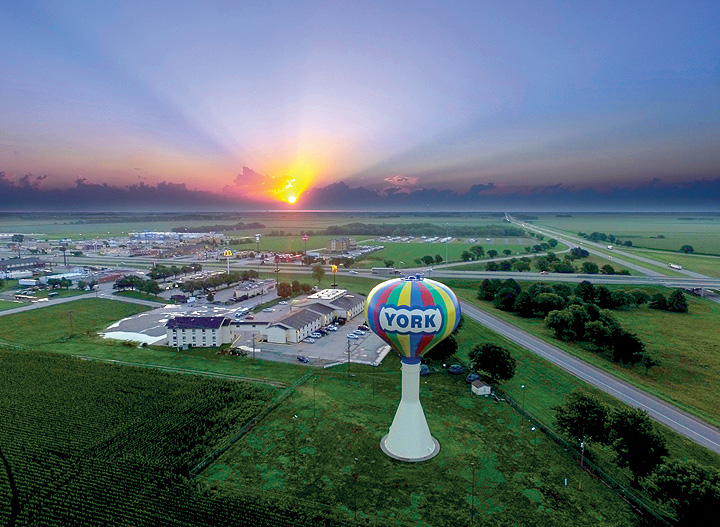

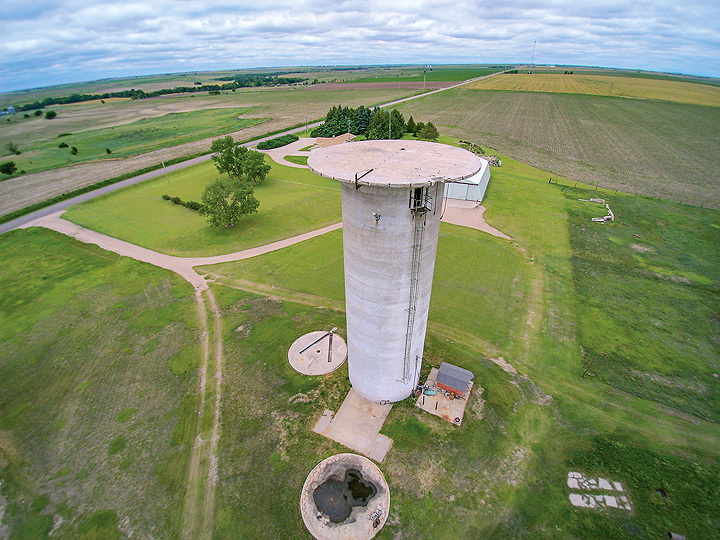
Across Nebraska, water towers rise from the prairie as landmarks that tell local stories. In Oshkosh, the century-old tin man tower survived near-demolition to become a community landmark. In York, a pilot’s vision turned a plain tank into a cheerful hot air balloon that greets travelers at the crossroads of I-80. In Ogallala, a UFO hovers above the plains, drawing curiosity from the highway.
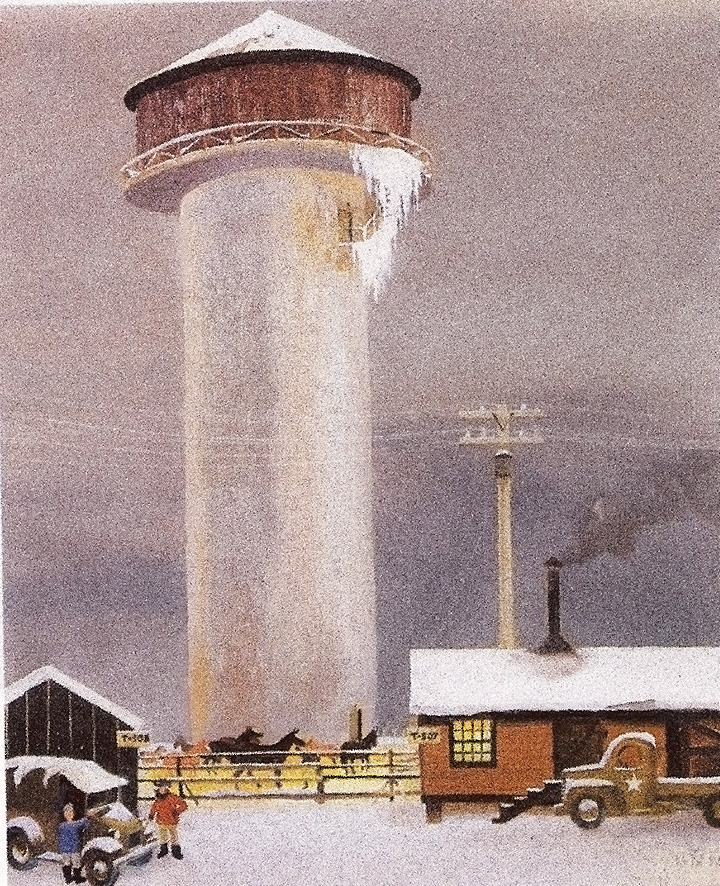
Not all towers remain whole, but even ruins tell a story. At Camp Indianola, the skeletal frame of a water tower marks the site of Nebraska’s World War II prisoner-of-war camp. Together, these towers show how the most utilitarian structures can become symbols of identity and imagination across the Great Plains.
Historic Oshkosh Water Tower
103 E Ave, Oshkosh
When Oshkosh’s 105-year-old “tin man” water tower was slated for demolition in 2018, Jo Lynn Petty Blackwell’s heart broke. The looming sentinel was a beloved beacon for Blackwell and about 700 residents of this Garden County community.
“It’s just not Oshkosh without the tower,” Blackwell said. “You can see it from miles in any direction. That’s how you know you’re home.”
The rare tin man-style tower was built in 1920 and played a central role in Oshkosh’s development. But when the tower became obsolete after it ceased operating in 2018, the city announced its teardown, spurring Blackwell, her husband and eight other friends to restore it.
The group formed a nonprofit and sought donations to purchase the tower from the city. Alumni, residents and visitors initially pledged $13,000 and later exceeded that in donations, allowing the nonprofit to buy the tower in November 2018.
Blackwell, the group’s president, and members of the nonprofit got to work to make the site a gathering place. They repainted the tower and added a garden, plaza, barn quilts, metal sculpture and a mural by local artist Lauren Olson featuring a sandhill crane amid a floral background.
Four hundred commemorative bricks line the plaza below, honoring donors who helped save the tower. While collecting donations for memorial bricks, Blackwell received notes detailing family memories around this Great Plains settlement.
Some donors recalled relatives arriving in covered wagons and living in a blowout with a hide cover over the door. Another story told of a plane that dropped groceries for neighbors in the Winter of 1948-49. Blackwell compiled 150 of these stories into a book titled If These Bricks Could Talk.
“The tower is a real touchstone to everyone here,” Blackwell said. It is now the first and only Nebraska water tower listed on the National Register of Historic Places. The tower was also on the WanderNebraska and Nebraska Passport programs in 2025 and won the History Nebraska Preservation Award in 2020.
The tower lights up nightly, sometimes purple in the town’s colors or holiday themed. All of Oshkosh shows out each July for Party at the Tower, a block party with live music, dancing, food and community pride.
While the tin man no longer pumps water, it still delivers something vital. With its fresh paint, glowing lights and stories etched into its bricks, the tower remains Oshkosh’s defining landmark.
York Hot Air Balloon Water Tower
Intersection of Interstate 80 and Highway 81
At the crossroads of Interstate 80 and Highway 81, there is no mistaking York. The town’s balloon-painted water tower rises 130 feet above the prairie and has become as much a roadside icon as a reservoir, guiding travelers off the highway and into the community.
The tower wasn’t always eye-catching. Built in the early 1990s, its purpose was practical – more water capacity for firefighting and a growing city. But Marty Rousseau, a commercial pilot with a knack for big ideas, thought it deserved more than a plain coat of paint.
He served on the York County Visitors Committee in the 1980s and pitched his vision to City Council to turn the tower into a giant hot air balloon. “He thought it should be more than just a bleached blob,” said his daughter, Vicki Fairchild. “He wanted it to be something people would remember.”
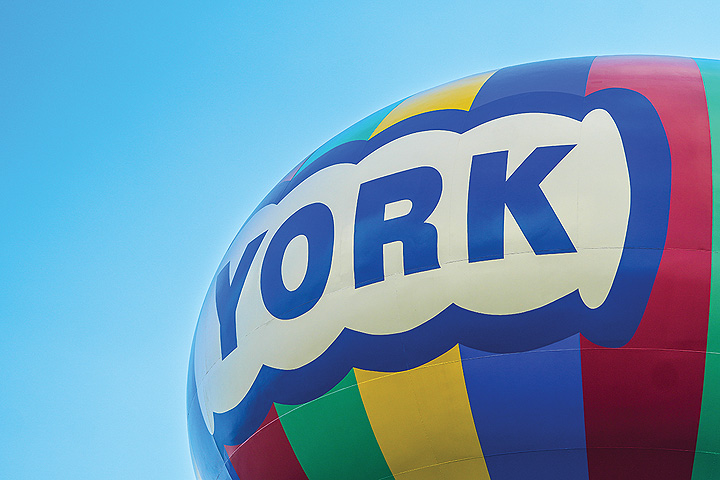
York embraced the idea. In 10 days, Rousseau raised enough money to bring the balloon to life, prompting a local newspaper to run a design contest. Local Lynn Christiansen submitted the winning design, and in 1998 the tower was transformed into a striped balloon. Rousseau jokingly called it “my big balloon,” and some of his grandchildren truly believed it belonged to him.
Today, the balloon tower holds 750,000 gallons of water – roughly half the amount York uses in a day – and stands opposite the city’s other water tower, which stores an additional 1 million gallons.
The balloon remains a landmark woven into community traditions. Each July, York hosts Balloon Days, a summer festival named for its sky-high icon. And in 2016, 15 local artists reimagined the tower in miniature with personalized five-foot fiberglass versions scattered around town in a public art scavenger hunt.
Both practical and playful, York’s balloon tower is more than a water tank. It reflects the city’s pride in rising above the ordinary.
UFO Water Tower
Big Mac Road, Ogallala
If you’re driving I-80 near Ogallala after dark, you might do a double take.
Just south of the interstate, off Exit 126, the town’s UFO water tower is painted to resemble a flying saucer readying to land. For the best effect, locals say, come after sunset – that’s when the painted portal windows glow against the night sky and the green alien peeks out, ready to beam you aboard.
The tower has been part of Ogallala’s skyline since the 1970s, but its extraterrestrial makeover came a decade later, thanks to a pair of creative locals. Newspaper editor and businessman Ed Sykes floated the idea, and longtime sign painter B.J. Reiselman made it a reality.
Perched high above town, Reiselman handled the tricky brushwork, while his father, Ben, hauled heavy buckets of paint up by rope from the ground. The result was a spaceship-shaped landmark that garnered attention from around the nation and quickly became the community’s most recognizable calling card.
Earlier this year, just shy of his 100th birthday, Reiselman passed away – but he was especially proud of the handiwork that put his town on the map.
Beneath its extraterrestrial paint job, the UFO still serves a down-to-earth purpose: supplying municipal water. The tower’s fame has even spilled into local culture. Second Chapter Brewing, housed in the old city library on West A Street, honors the icon with “Sci-Fi-PA,” a hazy IPA brewed with Vista, Galaxy and Comet hops. Husband-and-wife team Richard Gibson and Lisa Kraus co-own the community taproom.
“We love to name our beers after things that are meaningful to our community,” Kraus said about the brewery. “When I brought my future husband home to Ogallala for his first visit, we arrived late at night. The water tower was the very first thing I showed him in town.”
Quirky, practical and a tad mysterious – Ogallala’s UFO water tower shows how an ordinary structure can take flight with the right imagination.
Camp Indianola
1.5 miles north of Indianola
Just 1.5 miles north of Indianola, the tall-grass prairie holds faint remnants of a world at war. A few concrete foundations, two brick chimneys and the skeletal frame of a water tower are all that’s left of Camp Indianola, one of Nebraska’s four World War II prisoner-of-war camps that ran from 1943 to 1946.
Camp Indianola opened in November 1943 and housed German soldiers captured in North Africa and Italy. The Red Willow County camp spanned 250 acres with nearly 200 buildings and space for 3,000 prisoners. At its peak, 2,549 men lived behind its fences.
The original plan was to put the prisoners to work on flood control projects, but wartime labor shortages changed that. Instead, the camp became a vital agricultural hub, contracting out POWs to work for local farmers.
For many in southwest Nebraska, the memory of the camp is one of mutual respect. Locals recall that, despite being labeled enemies, the German soldiers worked alongside farmers. The U.S., determined to follow the Geneva Convention, ensured the prisoners were treated with dignity – a point of pride for Indianola residents.
The story of Camp Indianola survives not just in its ruins, which can still be found north of town, but also in art. The Nebraska Prairie Museum in Holdrege hosts exhibits featuring paintings by Thomas Naegele, a German-born refugee drafted into the U.S. Army. He was assigned as an interpreter at Indianola and spent his free time painting scenes of daily life at the camp.
The site was added to the National Register of Historic Places in 2019, and today the weathered water tower frame still rises from the grass – a reminder of how global conflict reached into the heart of Nebraska, and how this community carried out its role with resolve.



The information below is required for social login
Sign In
Create New Account